A vehicle detailing course is often the first serious step for anyone who has spent hours watching detailing videos on YouTube and thought about starting their own car care business. You are not alone; demand for professional car care is growing in many Indian cities.
But there’s a big difference between watching videos and actually knowing how to handle a customer’s car safely and professionally. This is where proper training helps, whether you start with an online course or jump straight into hands-on practice.
What Is a Vehicle Detailing Course?
A vehicle detailing course is a structured training program that teaches you how to clean, restore, and protect a vehicle’s interior and exterior using professional methods, products, and equipment. Unlike a regular car wash, it goes much deeper, with paint correction, interior deep cleaning, protection coatings, and correct machine use.
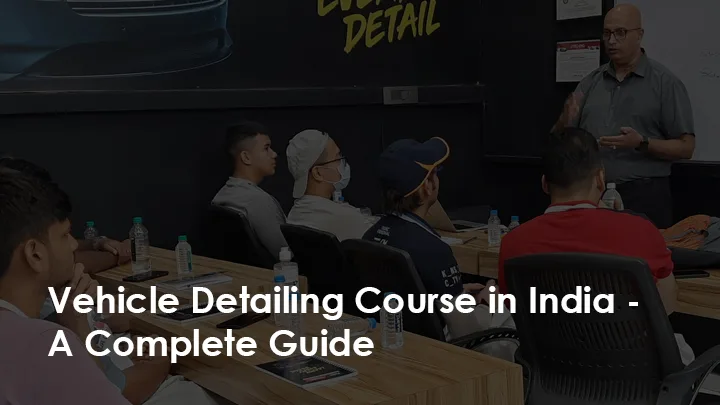
Courses generally come in two formats. Online car detailing courses build your conceptual and business understanding at your own pace. Offline (hands-on) courses add practical, in-person training where you actually work on a vehicle under guidance.
Beginners often understand the basic idea of detailing before joining training but struggle to choose the right product, pad, or machine for a surface. This is why both conceptual and practical learning matter; they solve different problems.
Why Should You Take a Vehicle Detailing Course?
An online course can organize your learning far better than random videos, covering business planning, product knowledge, and industry structure systematically. It’s often the most sensible starting point if you’re still deciding whether detailing is right for you.
But some things a video can’t teach: how a compound feels on your hand, how much pressure a polisher needs, or how to spot a paint defect under the right light. This is where hands-on training adds real value.
Using the wrong pad or compound on a customer’s car can damage the paint and cost far more than the course fee. Working under a trainer before taking paying customers builds confidence that’s hard to get elsewhere.
The real difference isn’t that one format is “better”; one builds judgement and business readiness, and the other builds physical technique. Most serious beginners benefit from both, at different stages.
What Do You Learn in a Vehicle Detailing Course?
A well-structured course, online or offline, usually covers vehicle inspection, checking paint condition, swirl marks, and problem areas before starting work. You’ll also learn washing techniques that avoid adding new scratches, plus interior and exterior detailing for seats, dashboards, carpets, wheels, and glass.
Paint care is another major part, including paint correction for swirl marks and oxidation and machine polishing using dual-action or rotary polishers safely.
You’ll also cover chemical and product selection, so you know which product suits which surface, plus the basics of ceramic coating and surface prep. Offline courses typically add proper tool handling and safe working methods too.
Not every course covers all of this in depth, so ask exactly what’s included and whether it’s taught conceptually or with real practice time.

Online vs Offline Vehicle Detailing Course
| Aspect | Online Course | Offline (Hands-on) Course |
| Best for | Understanding business planning, products, and structure | Learning actual technical skills through practice |
| Learning style | Self-paced, watch and read | Guided, real-time correction |
| Machine practice | Limited or theoretical | Hands-on practice with professional equipment |
| Paint correction | Learn concepts and processes | Practise techniques on actual vehicle surfaces |
| Trainer feedback | Limited | Immediate feedback during practical work |
| Investment | Usually lower cost | Usually higher cost, includes studio access |
| Limitation | Cannot replace physical practice | Requires travel and fixed schedule |
Neither format is incomplete for the goal it serves. An online course is genuinely useful if you want to understand the business and avoid early mistakes before spending money.
If your goal is to actually perform detailing services yourself, hands-on training becomes essential. Many aspiring detailers do both, starting online, then moving to practical training.
Practical Training vs. Learning on Your Own
Self-learning through videos, articles, and online courses builds real understanding, especially around business planning and product knowledge, before investing in more expensive practical training.
But if your goal is to personally perform detailing work, hands-on training offers something self-learning can’t: real-time feedback. Mistakes get corrected immediately while you’re working on a car.
You learn how a polisher feels in your hand, how paint reacts to compounds, and how to judge technique for different surfaces. This muscle memory takes far longer to build through videos alone.
A sensible approach: build a base understanding through an online course first, then join a hands-on program to practice the technical skills.
How to Choose the Right Vehicle Detailing Course in India
The questions differ slightly depending on the format. For an online course, check how current and India-specific the content is, whether it covers business planning in real depth, and whether you get support after finishing.
For an offline course, start with the trainer’s real industry experience and whether they’ve actually run a detailing business. Ask whether training is genuinely hands-on or mostly demonstrations.
Also check the curriculum breakdown, training duration, and batch size; smaller batches usually mean more individual attention. For either format, a certificate adds some credibility but shouldn’t be your only reason to choose.
Look at post-training support, genuine student reviews, and how transparent the institute is about what the course does and doesn’t cover.
Questions to Ask Before Enrolling
- Who will actually train you (or create the course content)?
- How many years of practical detailing experience does the trainer have?
- How much of the course is hands-on, if any?
- Will you work on real vehicles?
- Which machines and products will you practise with or learn about?
- What topics are covered in the curriculum?
- How many students are there in each batch (for offline)?
- Is business guidance included?
- What support is available after training?
- What exactly does the certificate represent?
Can a Vehicle Detailing Course Help You Start a Business?
A good course, online, offline, or both, can improve your readiness, but technical skill alone isn’t enough. Running a successful studio also depends on solid business planning.
You’ll need to decide your service model and budget, choose a location with good visibility, and plan your studio setup, space, water supply, drainage, and electricity.
Pricing needs to be fair yet competitive locally, and you’ll need a plan for customer acquisition through local marketing, social media, and word of mouth. Good customer service and basic financial tracking round out the business side.
Training prepares you for this, but your actual outcome depends on execution, local demand, and consistent service quality. Buying expensive equipment isn’t the same as building a successful studio.
What Equipment Is Needed to Start a Detailing Business?
You don’t need everything on day one, but core equipment includes a pressure washer, wet-and-dry vacuum, a dual-action or rotary polisher, foam and wool pads, microfiber towels, and cleaning brushes.
On products, you’ll need shampoos, degreasers and all-purpose cleaners, compounds and polishes, interior cleaning and dressing products, and paint protection products like ceramic coatings.
Costs vary by brand, quality, and city, so check current pricing directly with suppliers. Focus on what your planned services actually require rather than buying every available machine or chemical.
Who Should Join a Vehicle Detailing Course?
These courses suit complete beginners, car enthusiasts turning a passion into a skill, and aspiring entrepreneurs exploring a new business. They also help existing car wash or garage owners who want to add detailing services.
If you’re still exploring the idea, starting online makes sense. If you’re ready to build the physical skill, offline training is the next step.
What Should You Do After Completing a Vehicle Detailing Course?
If you’ve done an online course, the natural next step is often hands-on training to build the actual technique. If you’ve completed practical training, keep practicing consistently before taking on paying customers.
From there, research your local market, plan your investment for equipment and workspace, and get your space ready with proper water, drainage, and electricity.
Decide your services and pricing based on your target customers, and build local visibility through social media, listings, and word of mouth. Start with quality-focused service rather than too many customers too fast.
Collect genuine feedback from early customers, and use it to gradually expand services, like adding ceramic coating or PPF, once your basics are strong.
Why Choose AutoFresh for Vehicle Detailing Training?
AutoFresh has been supplying detailing products and training to the Indian market for several years, offering two types of learning depending on what a beginner needs.
For those who want the business side first, AutoFresh Detailing Academy Online Detailing Course is a starter program. It covers what car detailing involves, tools and materials needed, choosing a location, identifying your target audience, and a downloadable equipment list. It’s not meant to teach physical detailing; it’s meant to help you plan your business and avoid early mistakes.
For hands-on technical training, autofresh runs a 6-Day Certified Detailing Training Course at its studio in Surat, Gujarat. It’s led by Mr. Anckur Sama, with 16+ years of experience and an IDA skill-validated detailer credential.
Batches are capped at 9 trainees, and the course covers paint assessment, washing, interior cleaning, paint correction, ceramic coating, and running the business side. Students get a certificate, post-training support, and a complimentary refresher session.
Both formats serve different needs; one builds business understanding, the other builds hands-on ability. Many aspiring detailers benefit from combining both.
About the Expert
Mr. Anckur Sama has more than 16 years of experience in car detailing and is an IDA Skill-Validated Detailer. He leads the practical training program at the Surat studio.
His background gives the offline course a practical foundation, especially useful for beginners who need to see how techniques apply in a real working environment.
If You Are Comparing Detailing Courses
Compare the actual learning experience rather than just the certificate or price. Look at:
- Trainer experience: Is the trainer an active industry professional?
- Practical exposure: Will you work on actual vehicles, or is it conceptual?
- Equipment: Are professional machines and products used or shown?
- Batch size (for offline): Will you get enough individual guidance?
- Business guidance: Does the course cover the business side?
- Post-training support: Can you ask for help after completing it?
- Transparency: Is it clear what the course can and can’t teach you?
Final Thought
Choosing a vehicle detailing course in India is an important decision if you want to turn detailing into a professional skill or business. Don’t choose based only on a certificate, low price, or promotional claims.
Look at the trainer’s real experience, the amount of practical training (if any), the equipment available, the curriculum, business guidance, and post-course support.
For most beginners, the strongest path combines a clear business understanding, which an online course builds well, with enough hands-on practice to develop real technical confidence.
FAQs
What is a vehicle detailing course?
A structured training program teaching the skills, products, and processes used in professional vehicle detailing, often including guidance on starting and running a detailing business.
Is a vehicle detailing course suitable for beginners?
Yes. Most courses, online or offline, are built for people with little or no prior experience, moving from basics to advanced techniques.
What do you learn in a vehicle detailing course?
Vehicle inspection, washing, interior and exterior detailing, paint correction, machine polishing, product knowledge, ceramic coating basics, and safe working methods.
Is practical training important for vehicle detailing?
Yes, especially if you plan to offer services professionally. Hands-on practice builds technique and judgement that videos alone can’t fully provide.
Is an online course enough, or do I need hands-on training too?
It depends on your goal. Online is enough if you mainly want to understand the business. If you’ll personally perform detailing, combine it with hands-on training.
Can I start a car detailing business after completing a course?
A course prepares you with technical and business knowledge, but success also depends on local demand, pricing, service quality, and consistent execution.
How do I choose the right vehicle detailing course in India?
Check the trainer’s real experience, whether training is hands-on or conceptual, the curriculum, batch size, equipment, and whether business guidance and post-training support are included.