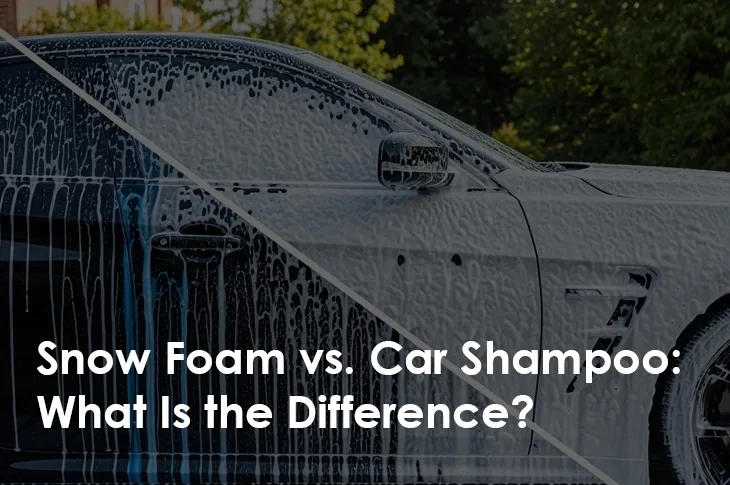
Car shampoo gets confused with snow foam more often than most detailers would like to admit, and that mix-up is exactly why so many “clean” cars still end up with swirl marks.
If you have ever watched a car disappear under a blanket of thick white foam and wondered whether that foam is doing the same job as a bucket of soapy shampoo water, you are not alone.
The short answer is no, they are not the same thing, and mixing up their roles is one of the most common reasons detailers end up with fine scratching on an otherwise “clean” car.
Snow foam and car shampoo both fall under the umbrella of car wash chemicals, but they are built for two completely different stages of the wash process. This is a question we hear a lot from detailers stocking their wash bay for the first time, and it usually comes down to the same confusion: thinking one product can substitute for the other.
Understanding that difference is not just a technical detail for enthusiasts. It is the foundation of a safe wash method, and getting it wrong is how perfectly good paint picks up fine scratches that only show up under sunlight or a detailing light months later.
What Is the Real Difference Between Snow Foam and Car Shampoo?
Snow foam is a pre-wash product designed to sit on the paint and loosen dirt without any physical contact, while car shampoo is a contact wash product meant to be used with a wash mitt to lift and carry away grime.
In simple terms, snow foam does the first pass with zero touch, and shampoo does the second pass with controlled touch. The two are meant to work together, not replace each other. This distinction matters more than it sounds.
A huge number of amateur washes, and honestly some professional ones too, skip snow foam entirely and go straight to shampoo and a mitt on a dry, dusty car. That is exactly the scenario where a mitt drags grit across clear coat and creates the fine spiderweb scratching that shows up as swirl marks under direct light.
Detailers who have stripped and corrected enough paint know this pattern immediately because it has a very specific look: shallow, random, multi-directional scratches concentrated on horizontal panels like the bonnet and boot lid where dust settles most.
Comparison Table:
| Feature | Snow Foam | Car Shampoo |
|---|---|---|
| Main purpose | Pre-wash | Contact wash |
| Paint contact | No physical contact | Used with wash mitt |
| Application | Foam cannon/sprayer | Bucket + wash mitt |
| Main action | Loosens contamination | Cleans remaining dirt |
| Used before/after | Before contact wash | After pre-wash |
| Main benefit | Reduces contamination before touching paint | Provides lubrication during contact wash |
Why Snow Foam Exists in the First Place
The main purpose of snow foam in a modern wash process is to help loosen and remove surface contamination before the contact wash.
Road film is not simply loose dust sitting on top of the paint. It can contain oils, dirt, exhaust residue, brake dust and other contaminants that adhere to the vehicle’s exterior.
Foam solves this by using surfactants and a thick, clinging texture that stays on vertical and horizontal panels long enough to break the bond between dirt and paint. Dwell time varies by product, dilution, temperature and contamination level, so the manufacturer’s recommended dwell time should always take priority. In many cases, this may be several minutes rather than just a few seconds.
Never allow snow foam to dry on the vehicle.
During that dwell time, the foam is doing chemical work, not mechanical work. Nothing is touching the paint. The dirt is being softened and partially lifted so that when you rinse with a pressure washer afterwards, a large percentage of the contamination comes off before a mitt ever gets near the car.
Professional detailers who run through several cars a day rely on this step specifically because it cuts down contact time. Less contact means less risk. It is the same logic behind the two-bucket wash method; reduce the amount of grit that a mitt has to physically push around on the surface.
What Car Shampoo Actually Does Differently
Car shampoo is formulated for direct contact cleaning. Where foam is designed to cling and dwell, shampoo is designed to lubricate the surface so that a wash mitt glides rather than drags.
This lubricity comes from the shampoo’s surfactant and polymer blend, and it is arguably the single most important property of a good shampoo, more important even than how much foam it produces or how nice it smells.
A shampoo with poor lubricity will feel gritty under the mitt even on a car that looks clean, and that grittiness is friction, and friction on clear coat over time is what creates marring.
This is why experienced detailers judge a shampoo not by its scent or foam height in the bucket, but by how the paint feels under the mitt during the second or third panel of the wash. If you can already feel drag by panel three, that product is not doing its job regardless of what the label promises.
This is also where product selection genuinely matters. We formulate the AutoFresh Car Wash Shampoo specifically around this idea, prioritising pH balance and lubricity over just aggressive cleaning power, because the goal at the shampoo stage is not to remove heavy contamination; that job has already been handled by the foam.
The goal is safe, low-friction contact cleaning of whatever residue remains, which is why we test lubricity on painted panels before a batch ever gets bottled, not just how much foam it throws in a bucket.
The pH Question Nobody Talks About Enough
One area where trustworthiness in this industry gets tested is the pH conversation. Some stronger alkaline cleaners can provide more aggressive cleaning, but they may also be less suitable for frequent maintenance washing of vehicles protected with waxes, sealants or certain coatings.
Frequent use of strongly alkaline cleaning products can reduce the longevity of some waxes, sealants and other protective products. For routine maintenance washing, many detailers therefore prefer a shampoo designed to be gentle on existing protection, often around a neutral pH.
This is not a dramatic, car-destroying problem, but it is a real trade-off, and any honest recommendation has to mention it. If you are maintaining a coated or waxed car and rewashing it every one to two weeks, a pH-neutral shampoo will preserve that protective layer noticeably longer than a harsher alkaline one.
Detailers who run maintenance contracts on ceramic-coated vehicles tend to standardise on neutral pH shampoos for exactly this reason, since coating longevity is often part of what the client is paying for.
Can You Use Snow Foam Alone Without Shampoo?
Technically yes, but it is not something most experienced detailers would recommend as a standard practice. Snow foam by itself removes a good portion of loose surface contamination, but it is not designed to fully clean bonded grime, road film residue, or the fine layer of oils that settle on paint between washes.
Skipping shampoo entirely might work for a quick maintenance rinse between full washes, but for a proper wash it leaves the job half finished. Similarly, using shampoo without a foam pre-wash is workable on a car that has just come out of a garage and picked up minimal dust, but on a daily driver that has covered real road miles, skipping foam significantly increases the mechanical risk during the contact wash stage.
The two products are complementary rather than interchangeable, and treating them as optional alternatives to each other is one of the more common misconceptions even among people who wash cars for a living.
Choosing a shampoo that pairs well with your existing foam, rather than switching between random products based on price alone, is usually the smarter long-term call.
This is exactly the gap we built the AutoFresh Car Wash Shampoo to fill, a neutral-pH formula meant to sit right after a foam stage without stripping whatever wax or sealant is already on the car.
Does the Order of Application Actually Matter?
Yes, and this is one area where sequence genuinely changes the outcome rather than being a matter of preference. Foam always goes first because its entire function depends on working on a dirty surface before any contact happens.
Applying shampoo first would mean introducing a mitt to a fully contaminated surface, which defeats the purpose of using foam at all afterwards.
The correct sequence is foam, dwell, rinse, then shampoo with a mitt, followed by a final rinse. Deviating from that order does not make the wash faster; it just reintroduces the exact risk that foam was meant to eliminate.
How Detailers Choose Between the Two for Different Vehicle Conditions
The decision of how much to lean on foam versus shampoo often comes down to how the car has been used.
A vehicle that has done motorway miles in wet weather will usually carry a heavier, more bonded layer of traffic film, and in that case a longer foam dwell time or even a second foam application before shampooing makes a noticeable difference to the final finish.
A car that has mostly done short urban trips in dry weather tends to carry looser dust, and in that case a shorter foam cycle followed by a standard two-bucket shampoo wash is usually sufficient. Reading the condition of the car before deciding on foam dwell time is a small habit, but it separates a rushed wash from a properly considered one.
Practical Takeaways from Actual Wash Bays
After doing enough washes to notice patterns, a few things become clear that do not always show up in product descriptions.
Foam thickness alone is not a reliable indicator of cleaning performance. A product needs enough dwell time to work, but the ideal dwell time depends on its formulation and the conditions. A thin foam layer left for eight minutes on a cold, shaded panel will often outperform a thick layer rinsed off after ninety seconds, because dwell time is what allows the surfactants to actually break contamination bonds rather than just sit decoratively on the surface.
Shampoo concentration should also be adjusted seasonally. In hotter weather, work on smaller sections and avoid allowing the shampoo solution to dry on the paint. Follow the manufacturer’s recommended dilution ratio rather than increasing concentration arbitrarily.
And rinsing between foam and shampoo stages is not optional, even though it is tempting to skip on a quick wash, because leftover foam residue mixed with shampoo can reduce the shampoo’s own lubricity, which brings back the very friction problem the whole two-step process was designed to avoid.
None of this is complicated once you have seen it play out a few dozen times, but it is easy to overlook when you are moving quickly through a booking schedule and treating both products as roughly interchangeable cleaning liquids.
Final Thoughts
Snow foam and car shampoo are not competing products; they are two stages of the same safe wash philosophy, one built for contactless contamination removal and the other for low-friction contact cleaning. Using both, in the right order, with attention to dwell time and shampoo lubricity, is what actually protects paint over the long run rather than just making a car look clean for a day.
If you are refining your wash process or restocking your bay, it is worth trying the AutoFresh Car Wash Shampoo alongside your current foam and judging it the same way we described above, by how the paint feels under the mitt by the third panel, not by how it smells in the bucket. Matching the formula to the pH and lubricity needs of the vehicles you actually work on will do more for your finish than defaulting to whatever is cheapest on the shelf.
Frequently Asked Questions
1. Is snow foam the same as car shampoo?
No. Snow foam and car shampoo serve different purposes. Snow foam is primarily used as a pre-wash to loosen surface contamination before the vehicle is touched, while car shampoo is used during the contact wash with a wash mitt to safely remove remaining dirt.
2. Can snow foam replace car shampoo?
Generally, no. Snow foam can remove a significant amount of loose and surface-level contamination, but it is not normally designed to replace a proper contact wash. For a thorough wash, snow foam should be followed by a suitable car shampoo and wash mitt.
3. Can I use car shampoo in a foam cannon?
It depends on the product. Some car shampoos are formulated for foam cannon or pressure washer applications, while others are intended specifically for bucket washing. Always follow the manufacturer’s recommended dilution and application method rather than assuming every shampoo can be used as snow foam.
4. What should I use first, snow foam or car shampoo?
Snow foam should normally be used first. Apply the foam to the vehicle, allow it to dwell according to the product instructions, rinse thoroughly, and then carry out the contact wash using car shampoo and a suitable wash mitt.
5. Does snow foam prevent swirl marks?
Snow foam cannot guarantee a swirl-free finish, but it can help reduce the risk of wash-induced marring. By loosening and removing some contamination before the wash mitt touches the paint, it reduces the amount of abrasive dirt that needs to be moved across the surface during the contact wash.
6. How long should snow foam stay on a car?
The ideal dwell time depends on the product, dilution, weather conditions, surface temperature and level of contamination. Follow the manufacturer’s instructions and never allow the foam to dry on the vehicle. In warm or sunny conditions, a shorter dwell time may be necessary.
7. Is snow foam safe for ceramic-coated cars?
Snow foam can be suitable for ceramic-coated vehicles, but its formulation matters. For routine maintenance, choose a product that is compatible with the coating and follow the coating manufacturer’s recommended washing procedure. Avoid assuming that every strong or highly alkaline cleaner is suitable for regular use on a ceramic coating.
8. Is pH-neutral car shampoo better for regular washing?
A pH-neutral shampoo is often a good choice for routine maintenance washing, particularly when a vehicle has existing wax, sealant or coating protection. However, pH is not the only factor that determines cleaning performance. Lubricity, formulation and the manufacturer’s intended use are also important.
9. Do you need a two-bucket wash after using snow foam?
For a thorough contact wash, using a suitable bucket-and-mitt method is recommended even after a snow foam pre-wash. Snow foam helps reduce contamination before contact, but it does not necessarily remove everything from the vehicle.
10. What is the correct order for washing a car?
A typical safe wash process is:
Pre-rinse → Snow foam → Dwell → Pressure rinse → Car shampoo/contact wash → Final rinse → Drying
The exact process can vary depending on the vehicle’s condition, existing protection and the products being used.
11. Is more foam always better?
No. A thick layer of foam does not automatically mean better cleaning. Product formulation, dilution, dwell time, contamination level and rinsing technique all affect performance. The foam should be allowed to work according to the manufacturer’s instructions without drying on the paint.
12. What makes a good car shampoo?
A good maintenance shampoo should provide effective cleaning while offering sufficient lubrication for safe contact washing. Look for a product with clear dilution instructions, suitable pH characteristics for your intended use, good lubricity and compatibility with the vehicle’s existing paint protection.
13. Can I wash a lightly dusty car without snow foam?
You can, but the safest approach depends on the condition of the vehicle. If the vehicle has meaningful surface contamination, a pre-wash can help remove some of it before contact. For a very lightly contaminated vehicle, a suitable maintenance wash method may be sufficient.
14. Can I use snow foam without a pressure washer?
Some snow foam products can be applied using a pump sprayer or other compatible application method, although the resulting coverage and foam characteristics may differ from a pressure washer and foam cannon. Always follow the application instructions for the specific product.
15. Which is better: snow foam or car shampoo?
Neither is simply “better” because they perform different jobs. Snow foam is designed to help loosen contamination before contact, while car shampoo is designed for the contact-wash stage. Using the right product at the right stage gives a safer and more effective washing process.