
Clay bar for car paint correction is one of the most trusted detailing steps used by professionals who want a truly smooth and flawless finish.
For car detailers, polishing and waxing alone are not enough when the paint surface has bonded contaminants stuck deep into it. Even a freshly washed car can feel rough to the touch because dirt, industrial fallout, road tar, brake dust and paint overspray often stay attached to the clear coat.
This is exactly why professional detailers across India and worldwide rely on clay bars as a regular part of paint preparation. It helps remove hidden contamination safely and leaves the surface clean, smooth and ready for polishing, waxing or ceramic coating.
Using a clay bar for car paint maintenance is a secret weapon that every professional car detailer in India swears by.
When a customer brings their car to your detailing studio, they are not just looking for a simple wash; they want that deep, mirror-like reflection and glass-smooth finish. But as a professional detailer, you already know that Indian roads are full of harsh elements.
From heavy construction dust and industrial smog to sticky tree sap and stubborn road tar, our cars face a constant attack.
At Autofresh, we work closely with car care professionals and understand what detailers need for better paint correction results. A quality clay bar for car saves time, improves finish quality and helps every detailing step perform better. Let’s understand the seven important reasons why car detailers continue to trust clay bars for car paint perfection.
Before we jump into the reasons, let us quickly understand what this tool is.
What Exactly is a Detailing Clay Bar?
A detailing clay bar for car is a special engineered resin compound. It feels very similar to the play-dough kids use in school, but it behaves completely differently. It is designed to glide across the automotive paintwork and safely catch, lift, and trap any microscopic dirt particles that are stuck on top of the clear coat.
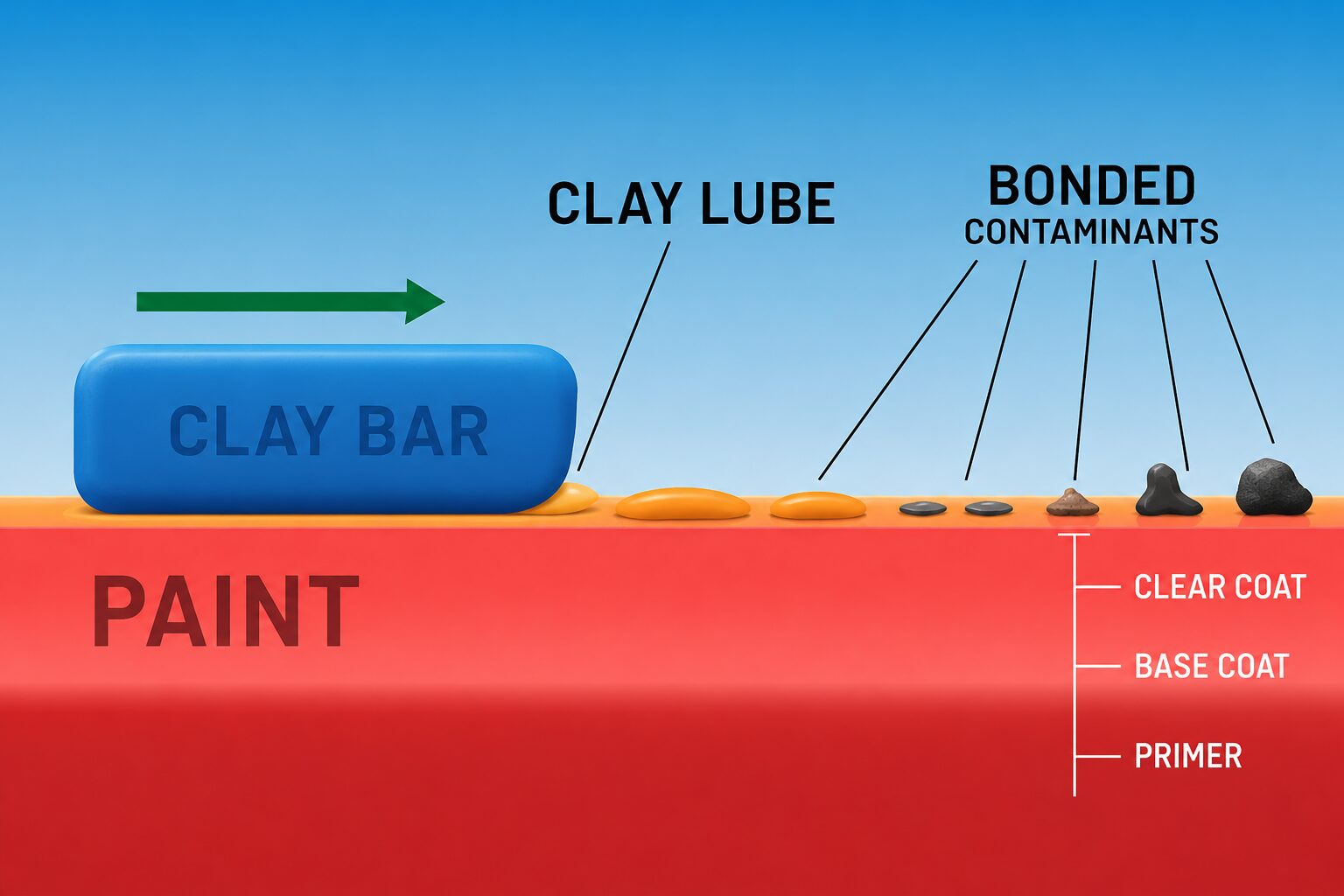
As you can see in the diagram above, the clay bar does not scrape or shave the paint. Instead, when used with a proper clay lubricant, it smoothly slides over the surface. The sticky nature of the clay pulls out the embedded contaminants without damaging the clear coat underneath.
Clay bar for car paint perfection is something we at Autofresh believe every detailer should use without fail.
We remember a training session very clearly. One of our students was practising on a silver Maruti Suzuki Dzire. The car had come back from a long road trip. The owner had already washed it two times.
To the eye, the paint looked very clean. But after a good foam wash, the student ran his hand over the bonnet. The surface felt just like sandpaper. There were also tiny orange rust dots on the doors and boot.
Washing alone is never enough. A simple piece of detailing clay did what the wash could not do. After teaching hundreds of detailers all over India, we can say this with full belief. Clay bar treatment is not something anyone can skip. It is the basic step that makes the difference between an average finish and a true mirror shine.
In this blog, we want to share seven simple and practical reasons. Every detailer, new or old, must always keep a clay bar kit ready. These lessons come straight from our training workshops. There, we show students how to handle real Indian road conditions. Monsoon mud, diesel smoke, construction dust, and sticky tree sap are all part of daily life.
1. It Removes Stuck-On Dirt That Washing Cannot Remove
No matter how good your car shampoo is, some dirt just bonds very strongly to the paint. We call this “stuck-on dirt.” It includes tiny brake dust bits, small iron pieces from factories or railway tracks, paint spray from nearby body shops, tar spots, and dried tree sap mist.
Over time, these tiny bits dig into the top layer of the paint. Some of them even start to rust. Then you can see small orange spots, mostly on white cars. A pressure washer and a wash mitt simply slide over them. They cannot pull these bits out.
This is where we show our students the real magic of a clay bar for car deep cleaning.
You gently rub the clay bar over the surface. The clay works like a magnet. It lifts off the top of these stuck bits and pulls them inside the clay. The paint becomes truly clean and smooth. In every training batch, we ask them to feel the surface before and after claying. The change is instant. It goes from rough to glass-like.
2. It Makes the Surface Smooth and Ready for Polishing
We often compare paint correction to understand better. If someone starts machine polishing on paint that still has tiny decontamination, they rub those hard bits against the top paint layer. This creates many fine scratches and can even cause deeper marks. Also, the costly polishing compounds gets wasted. It tries to cut through dirt that a clay bar could have removed safely.
At Autofresh, we teach a very simple rule that every student must follow. No polishing machine touches the car until the panel passes the “plastic bag test.”
Take a thin polythene bag and put your hand inside. Then gently run your fingers over the washed panel. If you feel even a little roughness, the clay bar must come out.
After claying, that roughness is fully gone. Now the polishing pad can do its real work. It can level the paint top layer and bring out the best gloss.
A smooth surface also means less polish is used. This saves the future detailer both money and time. So, we train every batch that a clay bar for car paint prep is a straight road towards a perfect finish.
3. It Helps Wax, Sealant, and Ceramic Coating Stick Better and Last Longer
A very common complaint we hear from our students who later open their own car detailing studios is this. “Sir, the customer says the wax was applied, but the beading disappeared within two weeks.” This means the water beading effect went away in just two weeks.
Most of the time, the wax is not the problem. The real problem is the surface it was applied on.
Any kind of protection, be it car wax, a synthetic sealant, or a ceramic coating, needs a very clean surface to stick properly. This sticking happens at a very tiny level that our eyes cannot see.
During our training session, we show this clearly. We use two same panels of a Honda City. The side that was clayed before waxing holds nice water beads for over four months. The side that is not clayed loses its beading in less than one month.
Why does this happen? If even a thin layer of sap, tar, or iron bits stays on the paint, the protective layer sits on top of that dirt. It cannot grip the paint surface firmly. When that dirt breaks down, the protective layer also comes off.
For students who want to offer ceramic coating services, we make it very clear. Skipping the clay step is like calling for a coating failure. In our pro-level coating courses, we always say it. A good clay bar treatment is the must-do bridge between washing and coating application.
4. It Stops Swirl Marks and Holograms During Buffing
Swirl marks are a car detailer’s biggest fear, and we make sure our trainees learn this early. Many beginners think swirls only come from dirty pads or wrong machine speed. We show them that unclayed dirt is equally to blame.
Think about invisible brake dust bits still stuck on the bonnet. When a polishing machine runs over them, those hard metal bits get caught between pad and paint. They act like sand and leave small round scratches. These scratches become very clear under sunlight or bright parking lights.
A proper clay bar session before polishing removes this risk completely. In our advanced correction workshops, we show this side by side.
The panel that is clayed first comes out clean and swirl-free after buffing. The panel that is skipped shows fine scratch marks. This one simple prep step saves our trainees from doing many re-polishing jobs later. It also stops customer complaints about hologram marks. For any detailer wanting a true perfect finish, the clay bar for car safety is the quiet helper that keeps the final shine clean and free from swirls.
5. It Brings Out the Real Colour and Shine Even Before You Polish
Right after claying a car, before any polish touches the panel, the colour already looks deeper and brighter. The stuck iron bits and thin tar layer scatter light and make the paint look dull.
This effect is very easy to see on dark colours. Black, deep blue, and burgundy are good examples. These colours are very popular on Indian SUVs.
Whenever we show claying on a black Mahindra XUV700 in class, the result is instant.
The moment we wipe off the lubricant, the black looks richer and almost wet. Why does this happen? The clay has removed that micro-layer of pollution that was stopping the light.
Now the paint top layer can reflect light evenly. Many trainees say that customers would ask, “Does Polish applied?” and the detailer can smile. Because the buffer has not even been switched on yet.
This instant shine boost builds customer confidence in a big way. It shows them that the process is working. It also sets the stage for an even better final result after polishing and waxing. A clay bar for car paint clarity is a wonderful way to show a detailer’s skill right from the start.
6. It Saves Time, Money, and Product in the Full Detailing Job
At first, adding a clay step looks like it will take more time. During our time-motion training sessions, we show a different truth. If you skip claying, you end up spending more time fixing problems caused by dirt. You use more polishing compounds because the surface fights back.
Pads also get clogged with tar spots and need to be changed. We show the numbers clearly. A twenty-minute clay bar routine on a mid-size sedan can easily save nearly forty-five minutes of extra polishing and clean-up work later.
We also teach that a good clay bar can be used many times. You just knead and fold it to show a fresh, clean side.
One 200-gram clay bar from the Autofresh range, when used with good lubricant and care, can easily do eight to nine full-size sedans.
When trainees calculate the cost of a clay bar against the polish, pad wear, and labour it saves, they understand quickly. It becomes one of the most money-saving tools in their future kit.
To every new batch, we always give this advice. Invest in a good clay bar for car deep cleaning before buying that tenth pot of costly wax. A strong base always matters more than the top shine layer.
7. It Builds Trust with Customers and Gives a Professional Image
Today, car owners are very smart. They watch car detailing videos on their phones and ask questions about swirl marks and paint protection.
In our soft-skills classes, we teach students how to explain each step to a customer in very simple words. When a customer sees a detailer doing a step that the normal roadside wash never does, their trust grows at once.
We train our students to say something like this: “Sir, think of it like an ubtan scrub for the skin. Washing is like putting water on your face. Claying is like removing the dead skin so the moisturiser can go deep and work well.” Customers understand this quickly and like the extra care.
Also, when a detailer gives a finish that feels super smooth and stays protected for a long time, customers talk about it.
Many of our past students now run good detailing studios. They tell us that their long-term fleet and big car contracts came because the cars they maintained simply looked cleaner and shinier for longer between washes. That performance difference comes straight from proper decontamination.
When a clay bar for car perfection becomes a regular part of their service, they show that they care about small things that normal washes miss. This lifts their image from just a polish-wallah to a real paint care expert. In today’s busy car detailing market, that good name is the biggest treasure of all.
Comparing Different Car Exterior Treatments
To train your detailing team or to explain things easily to your customers, look at this simple breakdown of what each step actually achieves:
| Treatment Type | Removes Loose Dirt? | Removes Embedded Grime? | Corrects Scratches/Swirls? | Adds Paint Protection? |
| Standard Car Wash | Yes | No | No | No |
| Clay Bar Decontamination | Yes | Yes | No | No |
| Machine Polishing | Yes | Partly (Risky) | Yes | No |
| Ceramic Coating | No | No | No | Yes |
Pro Tip from Experts: Always remember that a clay bar is designed to remove above-surface contaminants. It will not remove below-surface defects like swirl marks, scratches, or heavy water spot etching. For those issues, you will need to follow up with machine compounding and polishing.
How to Use a Clay Bar Like a Professional
sing a clay bar incorrectly can cause micro-marring (fine scratches).
Here is the exact procedure followed by top-tier Indian detailing studios:
Conclusion: The Clay Bar is Your Foundation, Never Just an Option
If we want every future detailer to remember one thing from this full blog, it is this. A clay bar for car paintwork is the quiet base on which all perfect finishes stand. It takes away what washing misses.
It prepares the surface for every product that comes next. And it shows the customer that you are a true professional who likes to do the job right.
Whether you are detailing a simple Maruti Alto or a top-end BMW, the smoothness, gloss, and long-lasting safety that a clay bar brings are always the same.
At Autofresh, we truly believe that great detailing begins with a perfectly clean surface.
That is why in all our training programmes, we give clay bar for car knowledge the full respect it deserves. We also offer professional clay bars that are soft, do not crumble, and are specially made for Indian car paints.
So, the next time a customer asks why their car still feels rough after a wash, you will know the answer. Pick up your clay bar for car, show them the change, and watch your name as a detailer grow higher and higher.